



Over the last few years there has been an increasing interest in accessible foods and medicines, and finding ways to heal, connect, and recharge through exploring nature. As a result, our team at The Conservation Foundation has expanded educational programming related to the practice of foraging, which is the practice of collecting and using wild plants in the local landscape. Although to some, the act of foraging may feel like a far-removed, obsolete practice from several generations ago, it is actually embedded in our collective human heritage and is another way to build relationships with native plant species, some species that are commonly viewed as weedy, and the land.
According to “Feasting Wild: In Search of the Last Untamed Food” by Gina Rae La Cerva, for 99% of human history, we ate gathered foods and up until 200 years ago, about 50% of North American diets consisted of gathered, wild foods. Even though many people today don’t consider themselves foragers, when asked specifically if they sometimes collect and eat wild berries, mushrooms, nuts, herbs, or greens, the number of foragers among us significantly increases. Foraging for plants like mulberries, raspberries, morel mushrooms, and amaranth or dandelion greens comes as second nature to many. Unfortunately, the vast majority of wild plant knowledge that our ancestors had has been lost with technological advances in commercial agriculture and worldwide food distribution.
Furthermore, anti-foraging laws, many of which were initially passed in the 1800s, forced communities to stop relying directly on the local ecosystem for foods and medicines. Much of the knowledge that we do know about the edible and medicinal uses of native plants is attributable to the deep understanding, relationship with and stewardship of these plants, and the generational information sharing of Native Americans taking place over thousands of years.
La Cerva notes in “Feasting Wild” that “Across North America, it’s estimated that prior to European contact, Native Americans used over 2,600 different plant species with nearly half exclusively used for medicine and less than 100 of these plant species were cultivated.”
Many of the non-native, weedy plants that people attempt to eradicate from today’s landscapes and gardens are plants that Europeans brought to the U.S. as culturally-important sources of food and medicine, but those plants escaped cultivation. While weeding, gardeners remove piles of lamb’s quarters, purslane, dandelions, garlic mustard, creeping Charlie, and wild onion, not realizing that these plants are not just for the compost pile or yard bag, but can be consumed.
As a land trust and watershed conservation organization that has an organic farming program (Green Earth Harvest) and a nature wellness program (Nature Rx), it’s important for us to create programs that connect people to the land and support healthy foods, healthy ecosystems, and healthy communities. Foraging education and programs check all of those boxes.
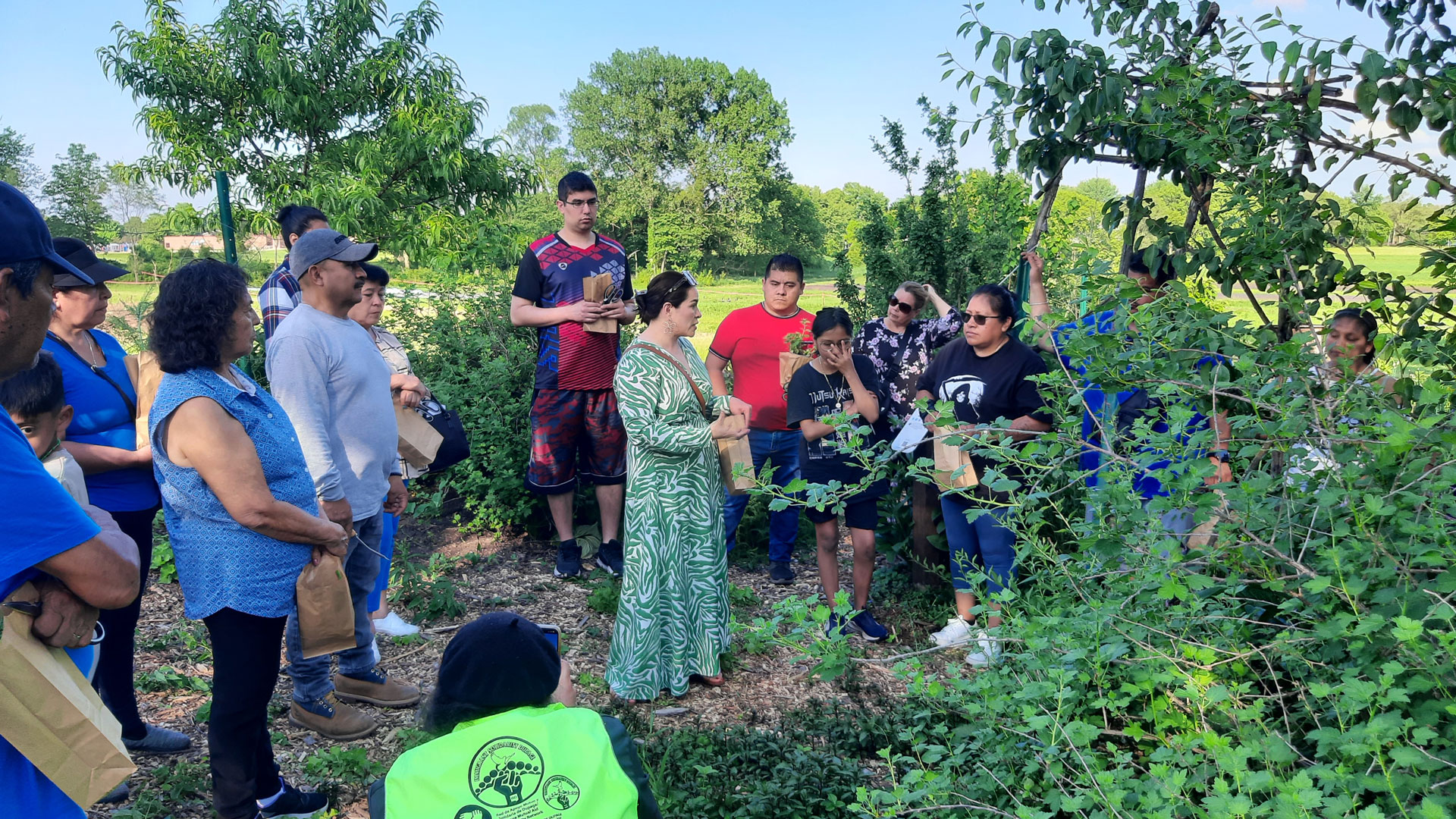
Since 2023, we’ve partnered with community organizations including Faith in Place, Outdoor Afro Chicago/NW Indiana Chapter, and Wilder World Trust to co-create foraging programs that emphasize safety, ethics, and proper plant identification. We have also collaborated with other foraging educators including Robin Greenfield and Shane Alden of The Wild Dryad to provide community events for libraries, colleges, garden clubs, and the general public with topics ranging from wild herbs and spices to foraging herbal plants for tea.
After a couple years of providing sampling and educational opportunities for our farm share members, our Green Earth Harvest farm program introduced lamb’s quarters, a close, wild relative of spinach, as an official vegetable selection option in this spring’s farm share program to broaden familiarity with this delicious spring-time green.
For those who are more comfortable with building their plant identification skills at home, adding native, edible and herbal plant species to your yard, a community garden, or a shared green space is a great place to start. With a food forest-style garden at our headquarters location at McDonald Farm in Naperville and the newly planted perennial edible garden at our Dickson-Murst Farm in Montgomery, we also invite people to explore those spaces during business hours to build plant ID confidence.
For the last three years, we’ve partnered with the Chicago Region Trees Initiative to distribute free native trees and shrubs with edible fruits or nuts in areas with lower fresh food access. Now, people living in these areas can start having perennial foods like serviceberries, wild plums, pawpaw, elderberry, and hazelnuts close to home while building habitat, nectar and food sources for pollinators, birds, and wildlife while adding biodiversity to their landscapes. This approach perfectly aligns with our popular Conservation@Home program.
Circling back to our unique role as a land trust and landowner, we are stewards of a large amount of privately owned land. Since foraging practices are currently prohibited at all local forest preserves and area parks, we recognize that we can play a role by working with organizations who still have foraging as a cultural and spiritual practice, and provide safe land access to bring foraging conversations back to the forefront of land stewardship.
We’ll be taking that conversation to the national stage in September at the Land Trust Alliance’s Rally Conference where we’ll co-present with the American Indian Center of Chicago about foraging. At the regional and state level, we and other organizations are starting discussions with public land managers about foraging-related needs, concerns, and policies within Illinois.
Matters related to foraging access and policies are complicated, and we are in the early stages of exploring the best ways to support sustainable foraging practices that align with conservation. The good news is that edible and medicinal plants surround us in the places we live, work, play, learn, and otherwise spend time. All that’s needed to get started is curiosity and learning plant ID, and starting to notice the community of distinct plants that share our spaces with us throughout the seasons. Building that deeper appreciation and understanding starts with one plant at a time.
Make sure to check out our events calendar to find upcoming opportunities to learn more about foraging and wild edible and herbal plants.
By Kyla Muhammad, The Conservation Foundation’s Will County Program Director