





Good day, readers!
It is a joy to be writing to you on this beautiful, calm, sunny day at McDonald Farm. Spring has been good to us and summer is starting off well. It’s hard to believe that in a few short weeks, we will be in the midst of the longest, sunniest days of the year! Before long, we will be seeding and planting fall crops, which is generally done after the summer solstice to avoid having cool-season biennial plants go to flower too soon. If crops like fall radish, purple top turnip, and rutabaga go in too early, they will try to flower right away rather than taking the time to develop sweet, hearty fall roots, so we wait.
Marching in step with the changing seasons, our changing crops are coming along well too. Peppers and tomatoes are growing strong, and outside of some moderate cucumber beetle damage, the summer and winter squash are starting to come up and form true leaves. The spring greenhouses are emptying fast, but still bursting with nutritious spring crops.
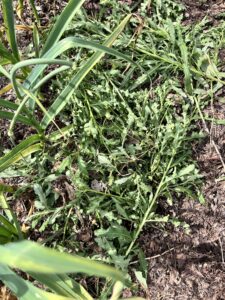 In addition to the vegetable happenings, this is also a key time for weed control and the biggest on the list is Canada thistle, everywhere. Canada thistle is a challenge to say the least, and once it is established, it makes any
 gardening difficult. Canada thistle is a perennial in the lettuce family that spreads both through suckering (sprouting shoots from the expansive root system) and prolific seed production. Step One is to mow the plants before they reach a 14-inch height, which is when they start to use the sun’s energy to grow more roots. Mowing early means that the thistle has to use up energy from its roots to sprout, rather than developing new roots. Step 2 is to mow before the flower heads open, which is right now. If allowed to seed, a thistle crop can produce millions of fluffy seeds that develop quickly and disperse in the faintest breeze. Finally, and this is my favorite tool in the thistle tool-kit, maintaining vigorous competition with cover crops to prevent thistle from spreading in our fields.
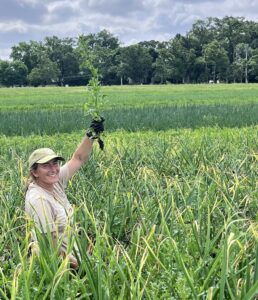
This morning, I visited three of our vigorously growing cover crop fields (covering more than three acres), to see how they’ve done. Last fall, we enrolled these fields in a study through the University of Michigan that aims to determine effectiveness and common uses of cover crops in the region. We enrolled three fields planted with rye, hairy vetch, and daikon radish last October. The daikon radish dies with a hard freeze, but develops deep roots that help to aerate soil and reduce compaction. Throughout the fall, winter, and spring, annual ryegrass and hairy vetch establish strong root systems that feed sugars produced through photosynthesis to the soil microbiota as well as to themselves. Then, in mid to late spring, these plants take off like rockets, growing quickly until reaching the apex of their growth and peak flowering. During peak flowering is when these plants are most effectively terminated, since all of the energy of the plant is busy making flowers and seeds. By this time, most other weeds in the field have been smothered out completely, or at least severely reduced thanks to the pressure of the vigorously growing cover crops. This year our over-wintered cover crop fields averaged 5 feet tall, with areas reaching as high as 6 feet! There is some patchiness in each of our three fields, as is expected, but the biomass production this year has been strong. With our rye and vetch in full flower and data recorded, we will terminate these plants soon using a flail mower.
We have already mowed other cover crop fields to reinvigorate the alfalfa and clover while removing flowering stalks of thistle plants. Fortunately, the benefits of using diverse cover crops reach far beyond thistle control. From storing and cycling nutrients; outcompeting weeds; working the soil with their large and diverse root systems; feeding the soil microbes; pulling carbon from the air; and feeding pollinators and other beneficial insects, cover crops do some heavy lifting for our farm and the environment! I find cover crops to be a great analogy for life, in that the secret to healthy communities is diversity and holistic thinking. By considering our whole community and our whole environment, and working together with diverse people in diverse ways, we can be the most effective stewards of our planet, our community, our family, and our own bodies. Nourishing the whole brings health to us all.
Happy weeding, everyone!